
Rainwater Harvesting & Flood Management – Rural Police Headquarters, Ahmedabad
- Apr 6
- 2 min read
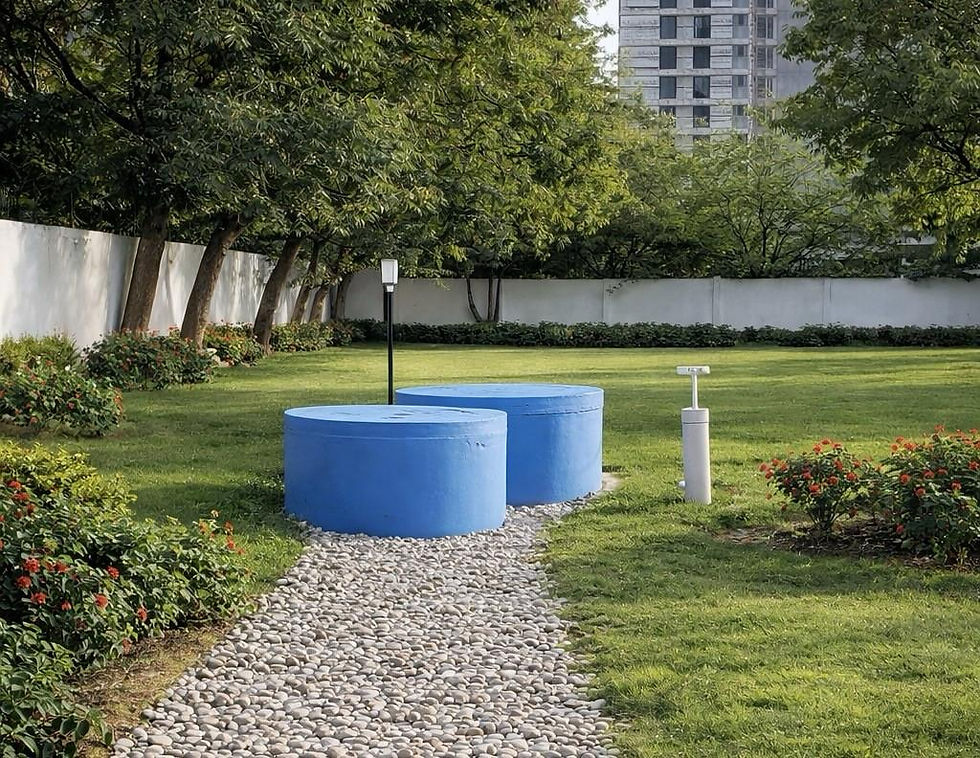
At the Rural Police Headquarters, Makarba- Ahmedabad, recurring waterlogging during monsoons had begun to significantly impact both campus usability and living conditions.
For a campus housing over 2,000 police families, it experienced heavy stormwater accumulation, with rainwater from across the campus accumulating in the parade ground—a natural low-lying zone. During peak monsoons, this led to prolonged waterlogging, affecting campus usability as well as the surrounding residential environment.
The Problem: Where stormwater became a challenge
The Spread across 70,000 sq. m, the campus generated significant stormwater runoff, with rainwater accumulating in the parade ground—a natural low-lying collection zone.
Waterlogging reached up to 2 to 3 feet.
The ground remained submerged for extended periods.
Temporary loss of usability of key infrastructure.
Continued impact on residential and operational areas
The Vision: Managing Water, Not Just Removing It
Rather than diverting water out of the site, the focus was to manage and utilize it within the campus itself.
The objective was to:
Control and regulate stormwater movement.
Reduce flooding and stagnation.
Restore usability of the ground.
Convert excess rainwater into a groundwater recharge resource.
Approach: Engineered Stormwater and Recharge System
Sujalaam carried out a detailed hydrogeological and site assessment, including rainfall analysis, runoff mapping, soil studies, and identification of clogging zones. This enabled the development of a site-specific, data-driven solution.
The implemented system integrates stormwater control with groundwater recharge:
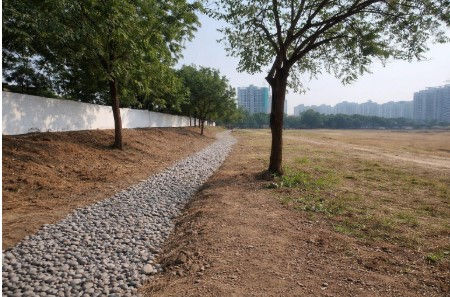
Swale & Collection System: A strategically designed collection depression - swale, along the parade ground boundary acts as the primary holding and filtration zone, slowing runoff and enabling controlled water movement.
Recharge Wells: The collected water is diverted into 3 recharge wells, positioned at depths of approximately 120 meters, allowing deep aquifer recharge through natural percolation.
Monitoring Systems: The system is reinforced with digital monitoring for real-time tracking and performance assessment.
Impact
Significant reduction in waterlogging and flood duration
Restoration of parade ground usability.
Improved health and sanitation conditions.
~90 lakh liters annual groundwater recharge
Strengthening of local aquifer systems.
The campus has evolved into a water-resilient environment, where rainwater is no longer treated as a problem to be drained away, but as a resource that is captured, managed, and returned to the ground.
From waterlogging to water stewardship — where every drop is guided back to the earth, not lost, but returned with purpose.



Comments